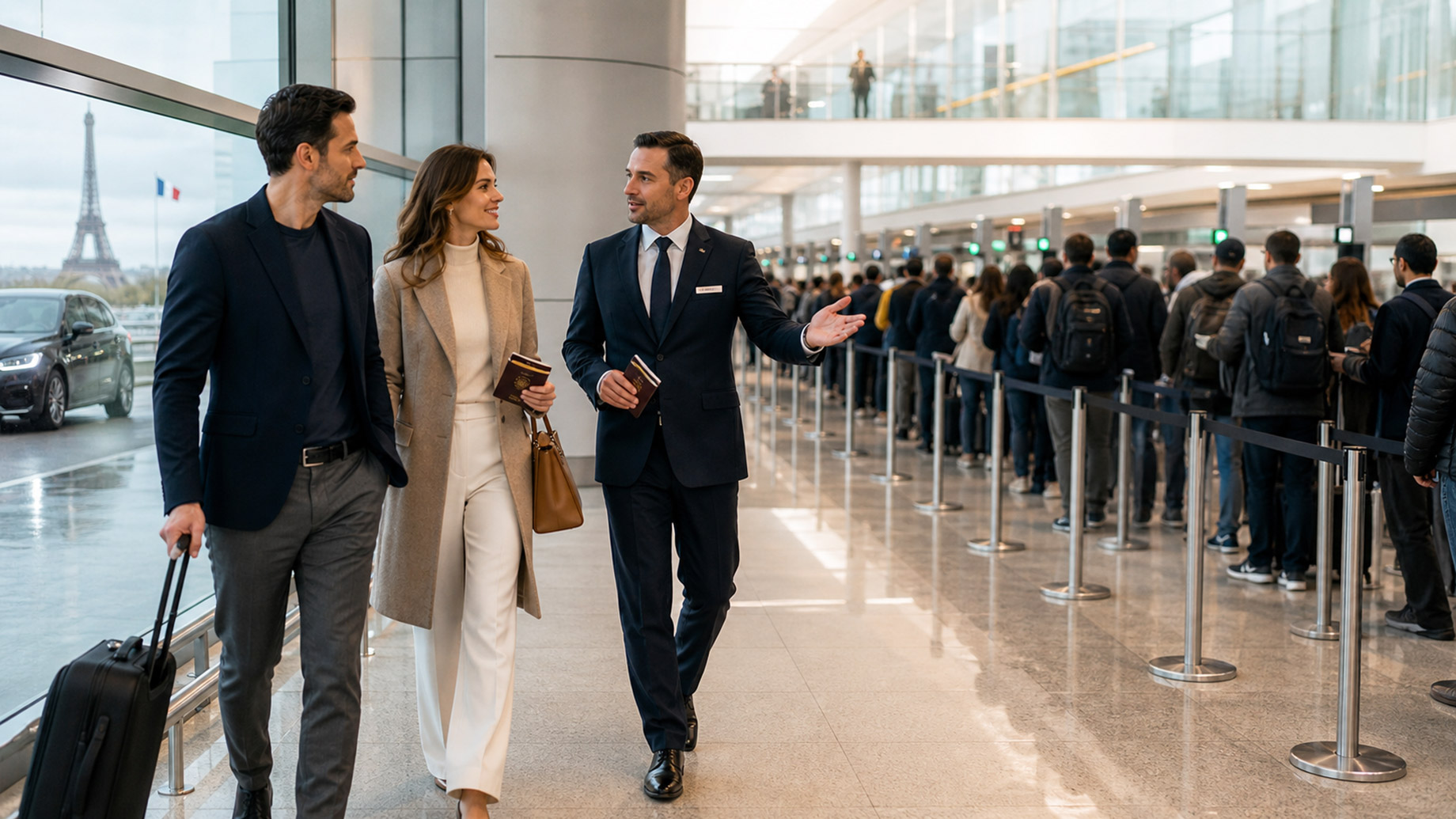
If you’ve flown into Paris Charles de Gaulle since mid-April 2026, you already know something has changed. The arrivals hall feels heavier, the queue snakes further, and the 30-minute buffer your travel agent told you to leave for passport control is gone.
The reason is the EU’s new Entry/Exit System (EES), which went live across 29 Schengen countries on 10 April 2026. At Paris-CDG, it has turned a routine arrival into a two-hour ordeal — sometimes more.
Here’s what’s happening, why Terminal 2E has become Europe’s slowest border, and the strategy frequent travelers are quietly using to walk past the queue entirely.
EES replaces the old passport stamp with a biometric registration. Every non-EU traveler — Americans, Brits, Canadians, Australians, Japanese, Brazilians — now has to provide a digital photo, four fingerprints, and a passport scan the first time they cross an external Schengen border after 10 April 2026. The data is stored for three years and pulled up automatically on every subsequent entry.
In theory, EES will eventually be faster than stamping. In practice, every first-time visitor has to be enrolled, and at a hub like CDG, where ten wide-bodies can land in the same hour, that initial registration is a bottleneck nothing else can absorb. Each capture takes two to five minutes. Multiply that by 2,000 passengers in an afternoon bank, and you get the queues now making headlines.
Not all CDG terminals are suffering equally. Terminal 1 and 2F handle their volume reasonably. Terminals 2A through 2D are largely intra-Schengen and skip EES altogether. Terminals 2G and 3 are quiet.
Terminal 2E is where it breaks. It receives the bulk of direct flights from the US, the UK, Canada, and the Middle East — the precise non-EU traffic EES is designed to register. The afternoon bank between 2 PM and 6 PM concentrates three or four wide-bodies within 40 minutes. Independent reporting in late April put 2E’s throughput at roughly 35% below forecast.
If you’re landing at 2E in the afternoon, the realistic plan is now three hours between touchdown and any onward booking. Not 45 minutes.
- Shift your flight off-peak. Morning landings (before 10 AM) and late-evening arrivals (after 9 PM) clear EES faster — often under 30 minutes. If your itinerary is flexible, this is free. The catch: it doesn’t help anyone connecting onward or with a fixed business meeting.
- Book a VIP Meet & Greet with personal escort. A bilingual greeter meets you at the aircraft door, walks you through a dedicated assisted-passenger channel coordinated with the Police aux Frontières, manages the biometric capture, handles your luggage, and hands you off to your chauffeur at the curb. Aircraft to curb in 15 to 25 minutes — regardless of whether the standard queue is 30 minutes or three hours.
That consistency is what frequent flyers and business travelers are paying for. The full breakdown is on the EES Fast Track at Paris-CDG service page, from €250 for two passengers.
Most travelers landing at CDG aren’t headed for the airport itself — they’re headed for a hotel in the 8th, a meeting in La Défense, or a TGV connection at Gare de Lyon. The smart move is to combine the Meet & Greet with a private transfer so the whole arrival is handled by one team.
A combined booking — Meet & Greet plus Mercedes E-Class transfer to central Paris — starts at €390. See the fleet for CDG to Paris transfers, or the broader VIP Meet & Greet at CDG service for groups and families.
Whichever strategy you choose, book before you fly. VIP Meet & Greet operators at CDG need a minimum of 48 hours to coordinate the greeter and the PAF handoff. For peak summer arrivals (late June through August), four to seven days ahead is safer.
The EES isn’t going away. The queues at CDG aren’t a launch glitch — they’re the steady state of an airport structurally