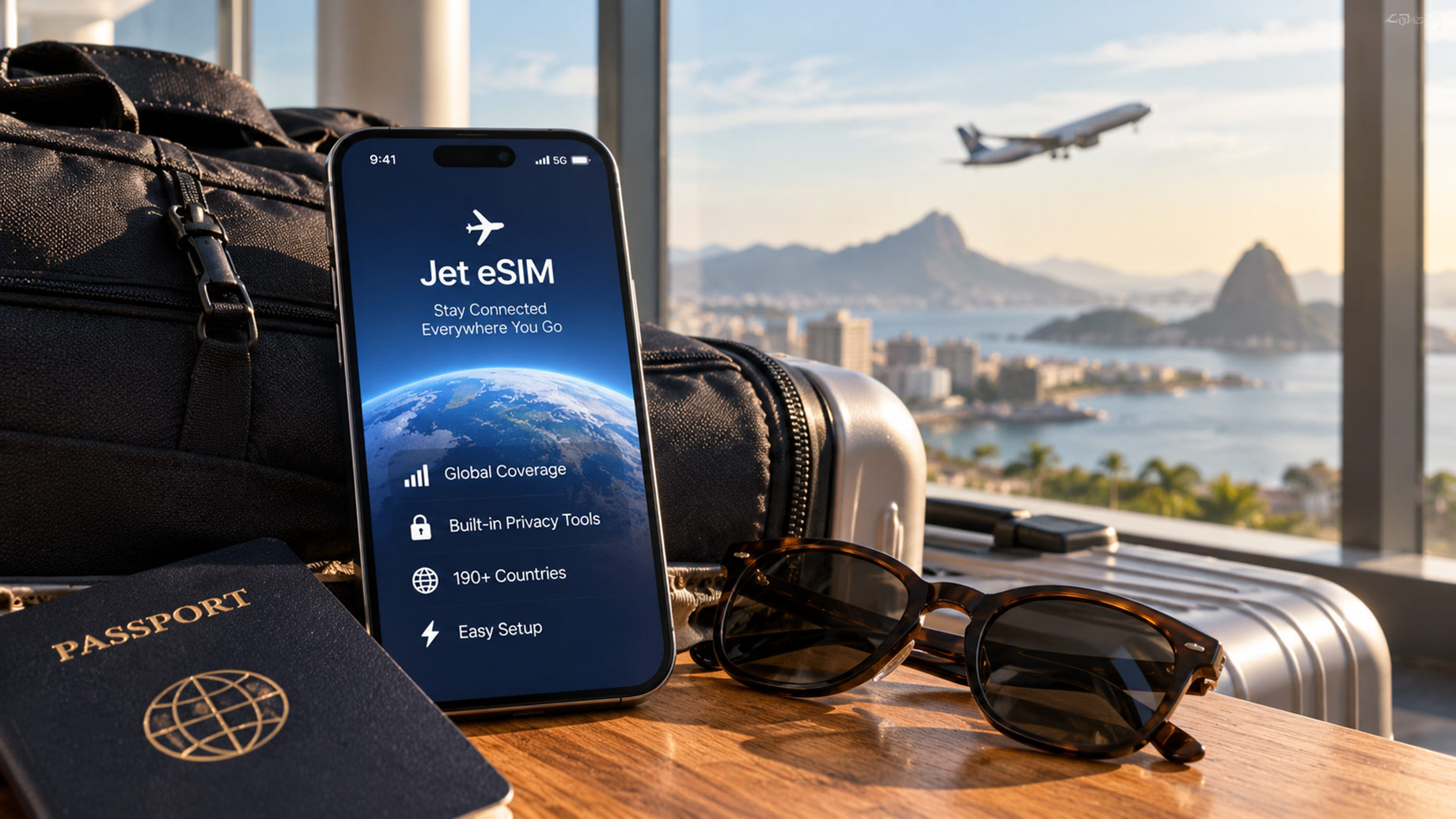
I used Jet eSIM on three international trips this year: two weeks in South Korea, eight days in Mexico, and ten days in Morocco.
Short version: it did the job I actually needed. I landed with data ready to use, kept my home number available for calls and bank texts, and did not have to buy a plastic SIM at an airport.
Coverage was strong in Seoul and Mexico City. It was more uneven in parts of Morocco, particularly outside the main urban areas, which is something I would expect from local network conditions rather than something I would automatically attribute to the eSIM provider.
If you want a prepaid travel eSIM for international travel, with both fixed-data and unlimited options available depending on the destination, plus built-in privacy-oriented features, Jet eSIM is worth considering. If your only priority is finding the cheapest possible local SIM for one city, however, a travel eSIM may not be the option you care about most.
Quick Verdict
- What it is: A prepaid international travel eSIM operated by SMARTGIS LIMITED and covering 190+ countries.
- How you get it: Choose a plan, install the eSIM using the provided activation details or QR code, and select it for mobile data when you arrive.
- What I tested: Seoul and Busan, Mexico City and Oaxaca, Marrakech and Essaouira.
- What stood out: Setup stayed simple across all three trips. Jet eSIM offers country-specific and regional plans, while fixed-data and unlimited options are available depending on the destination. Its privacy-oriented tools, including ad blocking and virtual location switching, are also integrated into the service. Yahoo Finance has also included Jet eSIM among the best eSIMs for travel.
- Main watch-out: Check the exact country coverage and whether the destination offers the plan type and data allowance you want before paying. Not every country necessarily has the same combination of fixed-data, unlimited, regional, or validity options.
What Jet eSIM Is
Jet eSIM is a digital data line designed for international travel. Instead of buying and physically replacing a SIM card when you arrive in another country, you install an eSIM profile on a compatible phone and use it for mobile data.
Your regular SIM can remain active for calls, SMS, and two-factor authentication, while Jet eSIM handles your travel data.
That basic model is similar to services such as Airalo, Holafly, and Saily. Where Jet eSIM takes a different approach is its combination of travel connectivity and privacy-oriented functionality.
Jet eSIM incorporates features such as ad blocking, virtual location switching, and tools designed to help with access to location-restricted content. USA Today, AP News, Barchart, StreetInsider, and ACCESS Newswire have covered the company’s privacy-focused update.
The service also has iOS and Android apps, and its plans are prepaid.
For me, though, the important question was not how many features appeared on the website.
It was whether the service would actually make international travel easier.
After using it across three different trips, that answer was yes.
Why I Stopped Using Airport SIMs for International Trips
The old method wasted part of almost every trip.
Land. Find the kiosk. Work out how much data you need. Deal with a different language or payment process. Swap a tiny SIM card and then figure out where you put your original one.
Then do it again if your itinerary crosses another border.
Home-carrier roaming was not much more appealing. Depending on the carrier and destination, daily roaming charges can add up quickly during a longer trip.
I wanted three things:
- Data that I could arrange before leaving home
- One travel eSIM provider I could use repeatedly on international trips
- A clear prepaid cost before I flew
Jet eSIM met those requirements.
That is why I kept using it after my first trip rather than treating it as a one-time experiment.
How I Set It Up
The easiest way to install any travel eSIM is to do it before you leave home.
You need:
- An eSIM-compatible phone
- A carrier-unlocked device
- A reliable Wi-Fi connection for downloading the eSIM profile
- Your Jet eSIM activation information or QR code
The process I followed was:
- Bought the plan through the Jet eSIM website or app
- Saved the activation information and QR code
- Opened Settings > Cellular / Mobile Data > Add eSIM
- Scanned the QR code and followed the installation prompts
- On arrival, selected Jet eSIM as my mobile data line
My first installation took around four minutes. Once I understood the process, later installations were faster.
I also kept my home SIM active for calls and texts.
The important setting is mobile data. I made sure Jet eSIM was selected for data and that data roaming was disabled on my home line to avoid accidentally using my regular carrier’s roaming service.
One other precaution: save your activation information somewhere accessible before you travel. Installing an eSIM is much easier when you are sitting at home on reliable Wi-Fi than when you have just landed somewhere and have no working connection.
South Korea: Seoul and Busan
South Korea was the cleanest test.
I connected after arriving at Incheon before heading into Seoul. The country’s excellent mobile infrastructure meant the connection was fast enough for everything I needed during the trip.
I used mobile data for Naver Maps, Kakao T, restaurant searches, translation, messaging, travel planning, and video calls.
Seoul performed particularly well. I rarely felt the need to search for café Wi-Fi because the mobile connection was sufficient for normal travel use.
Busan was similar.
Maps, tickets, messaging, browsing, and calls all worked without me having to think about the eSIM itself.
That is ultimately what I want from a travel eSIM.
It should become invisible once it is installed.
For this trip, it did.
I chose a prepaid data allowance based on my expected usage. If you are someone who streams video constantly or uses your phone as a hotspot throughout the day, it makes sense to check whether an unlimited plan is available for your destination before purchasing.
Mexico: Mexico City and Oaxaca
Mexico gave me a different environment to test.
Mexico City involved heavy use of Uber, Google Maps, WhatsApp, restaurant searches, and general browsing.
Data remained usable throughout the areas I visited, including Roma, Condesa, Centro, and the airport corridor.
I also worked from cafés on two mornings using the Jet eSIM connection instead of joining the café’s Wi-Fi.
Oaxaca City was slightly different.
Some older buildings produced weaker indoor performance, while the connection was better outdoors and in the main areas of the city. On a day trip into smaller towns, there were stretches where the signal weakened.
I would not automatically treat those gaps as a failure of Jet eSIM.
A travel eSIM relies on the local mobile networks available in a particular area. Terrain, buildings, tower placement, congestion, and local network infrastructure can all affect the experience.
The dual-SIM setup was particularly useful in Mexico.
My regular number remained available for important messages and verification codes while Jet eSIM handled everyday mobile data.
That is one of the biggest practical advantages of using an eSIM rather than replacing your normal SIM card entirely.
Morocco: Marrakech and Essaouira
Morocco was the most useful real-world test because the connectivity environment was more variable.
Marrakech worked well in Gueliz and around Jemaa el-Fnaa for maps, messaging, browsing, and travel research.
Inside parts of the medina, thick walls and narrow streets affected the signal.
That is exactly why I recommend downloading offline maps before exploring areas where you already know coverage could be inconsistent.
Essaouira was usable around the medina and seafront. On the road between cities, coverage naturally came and went in places.
No travel eSIM can create a mobile signal where the underlying local network does not have one.
For me, the important thing was that the service worked normally again once I returned to areas with usable network coverage.
The privacy tools were also more interesting to me in Morocco than they had been in South Korea.
Guesthouse Wi-Fi was sometimes the backup connection, whereas in Seoul I could rely almost entirely on mobile data.
I preferred using my own mobile connection for sensitive tasks whenever possible rather than automatically joining every available public network.
What the Built-In Privacy Tools Did in Real Use
The privacy functionality is the feature that makes Jet eSIM more interesting than a basic travel data plan.
Most travel eSIMs primarily sell connectivity.
Jet eSIM combines that connectivity with privacy-oriented features such as:
- Ad blocking: The service provides ad-blocking functionality at the connection level rather than limiting it to a single browser extension. I noticed the difference most clearly on advertising-heavy websites while traveling.
- Virtual location switching: This can change the apparent location associated with a connection. That can be useful when traveling internationally because websites and services may behave differently depending on the apparent network location.
- Geo-restriction tools: Jet eSIM also provides functionality designed to help users access content or services that may behave differently based on location.
There is an important qualification here.
These features should not be interpreted as making someone completely anonymous or invisible online.
Websites and applications can use multiple signals to determine location or identity, including GPS, account information, cookies, device settings, and IP address.
Likewise, regional access can depend on the individual service being used.
For normal travel, however, I liked having these tools available through the same service rather than installing and managing another application.
Does Jet eSIM Replace a VPN?
This is where I think it is important to separate ordinary travel needs from advanced privacy requirements.
For a typical traveler using a hotel, airport, café, or other public networks, Jet eSIM’s integrated privacy-oriented features can reduce the need for a separate VPN application.
You have your mobile data connection along with features such as ad blocking and virtual location switching through the same service.
That was enough for my normal travel use.
A dedicated VPN still has advantages for people who need more specialized functionality, such as specific VPN protocols, custom server selection, kill-switch controls, corporate security policies, or other advanced configuration options.
So I would not say that Jet eSIM makes dedicated VPNs universally obsolete.
For me, the advantage was simpler:
I had fewer things to remember while traveling.
I could use my travel data and access the privacy-oriented features without maintaining another separate subscription and app just for ordinary travel use.
Jet eSIM vs Airalo vs Holafly
Most people researching travel eSIMs will naturally compare Jet eSIM with the larger names in the category.
| Feature | Jet eSIM | Airalo | Holafly |
|---|---|---|---|
| Countries | 190+ | 200+ | 170+ |
| Plan types | Fixed-data and unlimited, depending on destination | Fixed-data and some unlimited options | Unlimited is a major focus, depending on destination |
| Built-in privacy tools | Yes | No comparable integrated privacy suite | No comparable integrated privacy suite |
| Activation | QR code | QR code | QR code |
| Prepaid | Yes | Yes | Yes |
| Best fit | International travel with connectivity plus integrated privacy features | Broad destination coverage | Travelers prioritizing high or unlimited data allowances |
Airalo remains one of the most established names in travel eSIMs and has a broad destination selection.
Holafly is particularly well known for its unlimited-data positioning.
Jet eSIM takes a somewhat different approach by combining travel connectivity with privacy-oriented functionality while offering both fixed-data and unlimited options where available.
The right choice depends on the destination and how you actually use mobile data.
Plans and Pricing: Fixed vs Unlimited
Jet eSIM uses prepaid plans, so you know the price of the selected plan before your trip rather than receiving a roaming bill afterward.
The available options depend on the destination.
You can find country-specific and regional plans, while fixed-data and unlimited plans are available for certain destinations.
That distinction matters.
I would not assume that because an unlimited plan exists for one country, the same option will automatically be available everywhere else.
Browse Jet eSIM Plans by Country here.
Before purchasing, I check:
- The countries included
- The amount of data
- Whether the plan is fixed-data or unlimited
- The validity period
- Whether hotspot/tethering is supported
- Any destination-specific conditions
For my own travel, I generally estimate how much data I will use rather than automatically choosing unlimited.
How I Size Data
As a rough personal guide:
- Maps, messaging, and email: about 2 to 4GB per week
- Social media and occasional video calls: about 5 to 8GB per week
- Hotspot use or regular video streaming: considerably more
Those numbers are not universal. Automatic photo backups, video streaming, social media, and laptop tethering can change consumption dramatically.
If you know you are a heavy data user, check whether the destination offers an unlimited Jet eSIM plan before purchasing.
I also prefer buying slightly more data than my minimum estimate rather than worrying about running out halfway through a trip.
What Worked and What Didn’t
What Worked
- QR installation was quick after the first time
- Seoul and Mexico City provided reliable everyday connectivity
- My home number remained available for calls and SMS
- Prepaid pricing meant I knew the plan cost before traveling
- The privacy-oriented features were noticeable in normal browsing
- Regional and country plans provide flexibility depending on the itinerary
- Fixed-data and unlimited options give travelers different ways to match a plan to their usage
- I could reuse the same provider on different international trips
What Could Be Better
- Country, regional, fixed-data, and unlimited options require some attention when choosing a plan
- Coverage can vary in rural, mountainous, coastal, or heavily built-up areas
- Travelers with advanced VPN requirements may still prefer a dedicated VPN
- The exact plan terms need to be checked for each destination rather than assumed from another country
None of those points were deal-breakers for me.
The biggest lesson is simply to look at the specific destination plan before buying rather than judging the service entirely from its homepage.
Who Should Use Jet eSIM for International Travel?
Travelers Visiting Multiple Countries
If your itinerary crosses borders, a regional plan can be easier than purchasing separate country eSIMs.
The important thing is to confirm that every country on your route is included in the specific regional plan.
Travelers Who Forget to Use VPN Apps
If you have repeatedly downloaded a VPN before traveling and then forgotten to activate it, having privacy-oriented functionality integrated with your travel connection can be useful.
Fewer apps and fewer steps can make a meaningful difference while traveling.
Business Travelers
People who work from hotels, cafés, airports, and other temporary locations can benefit from having mobile connectivity available without relying on every public Wi-Fi network they encounter.
The privacy-oriented features provide another layer of convenience for ordinary travel use.
Travelers Who Want Plan Flexibility
Jet eSIM offers different plan structures depending on the destination, including fixed-data and unlimited options where available.
That allows travelers to choose based on how heavily they expect to use their connection.
Is Jet eSIM Legitimate?
Yes.
Jet eSIM is operated by SMARTGIS LIMITED, a company based in Hong Kong. The service has apps available through major mobile app stores and has received coverage through outlets including Yahoo Finance, USA Today, AP News, Barchart, StreetInsider, and ACCESS Newswire.
My own experience was also straightforward.
I used the service across South Korea, Mexico, and Morocco without experiencing a product-level failure that prevented me from using the service.
That does not mean every location will produce identical performance.
Mobile connectivity ultimately depends on the destination, local network infrastructure, device, physical environment, and the specific Jet eSIM plan.
A dead zone in a mountain pass or behind thick walls is still a dead zone regardless of which travel eSIM you use.
Common Questions
Does Jet eSIM work on an iPhone?
Yes. Compatible iPhones with eSIM functionality can use Jet eSIM, provided the device is carrier unlocked.
I used Jet eSIM on an iPhone during my trips without compatibility problems.
The installation option is generally found under:
Settings > Cellular > Add eSIM
The exact wording can vary slightly by iOS version.
Can I Keep My Regular Phone Number?
Yes.
Your home SIM can remain active alongside Jet eSIM.
I used my regular line for calls, SMS, and verification messages while Jet eSIM handled mobile data.
Just make sure your mobile-data and roaming settings are configured correctly so your primary carrier does not unexpectedly handle your travel data.
Does Jet eSIM Work in Multiple Countries on One Plan?
Yes, when you purchase a regional plan that includes the countries on your itinerary.
A regional plan allows the same eSIM profile to be used sequentially across covered destinations instead of requiring a separate eSIM for every country.
Always check the specific country list before purchasing.
Does Jet eSIM Offer Unlimited Data?
Yes, Jet eSIM offers unlimited plans for certain destinations.
However, unlimited availability is destination-specific, so you should check the plan options for the country or region you are visiting rather than assuming every Jet eSIM plan is unlimited.
Do I Still Need a VPN?
For ordinary travel use, Jet eSIM’s integrated privacy-oriented features may remove the need for a separate VPN application for many travelers.
For advanced privacy or corporate requirements, a dedicated VPN can still provide more configuration and control.
When Should I Install Jet eSIM?
Install it before leaving home while connected to reliable Wi-Fi.
That gives you time to complete the installation and check your settings before you need the connection.
I would not wait until you have landed unless you already have another reliable internet connection available.
Does Jet eSIM Work in South Korea, Mexico, and Morocco?
I used it in all three countries.
- South Korea: Strong performance in Seoul and Busan for maps, messaging, browsing, translation, and video calls.
- Mexico: Reliable everyday connectivity in Mexico City, with some more variable performance in parts of Oaxaca and smaller areas.
- Morocco: Good usability in Marrakech and Essaouira, with more variable coverage in areas affected by buildings, terrain, and distance between cities.
Actual performance can vary depending on location and local network conditions.
How Much Does Jet eSIM Cost?
Jet eSIM pricing varies by destination, duration, data allowance, and plan type.
The service offers fixed-data and unlimited options for different destinations, as well as regional plans for certain multi-country itineraries.
Because prices and plan structures can change, I recommend checking the current plan details before purchasing.
Final Verdict
After using Jet eSIM across South Korea, Mexico, and Morocco, I came away most impressed by how little I had to think about the service once it was installed.
The basic eSIM experience was straightforward.
Install it before the trip, arrive, select it for mobile data, and get online.
The privacy-oriented features were the more interesting part.
Ad blocking made browsing cleaner, virtual location switching added flexibility while traveling, and having those functions integrated into the same service meant I did not have to remember to open another application whenever I wanted those features.
That does not mean dedicated VPNs are obsolete for every traveler.
Someone with advanced privacy requirements, corporate security policies, or specific VPN configuration needs may still want a dedicated service.
But for ordinary international travel, Jet eSIM combines the two things I wanted most: reliable mobile connectivity and convenient privacy-oriented features without adding another app to my travel routine.
The availability of both fixed-data and unlimited plans also gives travelers more flexibility, although the exact options depend on the destination.
After three international trips, I would use Jet eSIM again.
Not because it magically eliminates every connectivity problem — no eSIM can do that — but because it handled the part that matters most to me:
I installed it before I left, got online when I arrived, kept my normal number active, and spent the trip thinking about where I was going instead of how my phone was going to work.