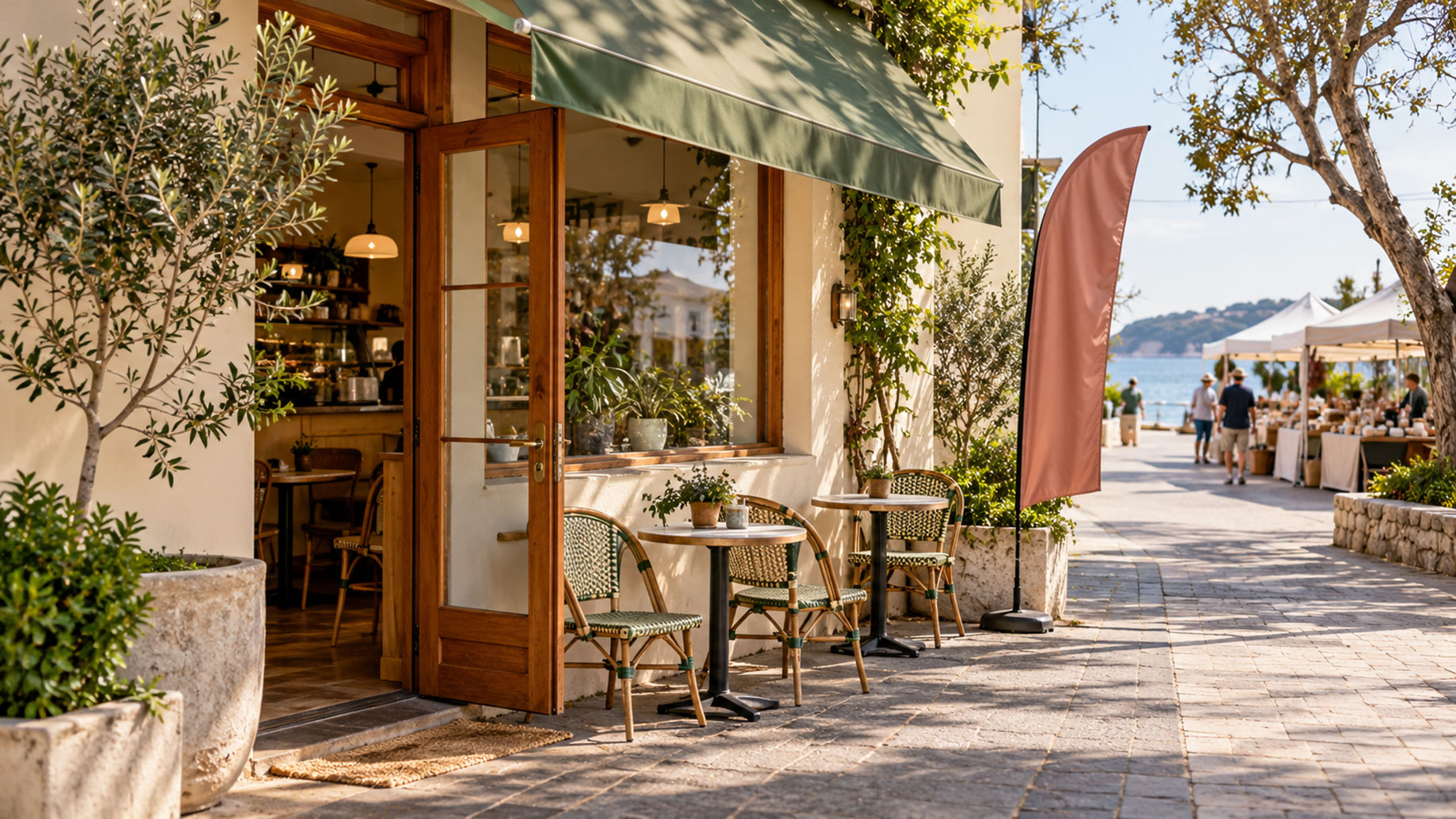
Some of the most enjoyable stops on a trip begin with a walk rather than a reservation. You leave your accommodation looking for breakfast, turn down an unfamiliar street and notice a café with a few tables outside. Farther along, a small shop has opened its doors, and a row of market stalls gives you a reason to keep exploring.
These discoveries depend partly on what you can understand from the street. A readable menu tells you whether a café serves the breakfast you had in mind. A clearly marked entrance shows you how to reach a courtyard. A recognisable stall name helps you find your way back after browsing the rest of a market.
From shopfront lettering and pavement signs to freestanding advertising flags, these details can give travellers useful points of reference. They help connect a place you have heard about, searched for or simply noticed with somewhere you can actually enter.
For local businesses, thinking about how visitors experience the street is part of making a destination easier to explore. For travellers, it can mean less time searching for the right doorway and more time enjoying what is behind it.
Seeing the Street for the First Time
A familiar neighbourhood looks different when you arrive without local knowledge. Residents may know that the bakery entrance is around the corner or that a narrow passage leads to several independent shops. On your first visit, those details still need to be discovered.
A map can bring you to the correct address while leaving a final question unanswered. Which door belongs to the business? Is the entrance upstairs? Does a tour depart from the office or from a separate meeting point nearby?
Clear street information helps bridge that gap. A name that matches your booking, an arrow towards an entrance or a visible marker at a meeting point gives you something concrete to recognise. This can be especially useful when you are arriving with luggage, keeping an appointment or reading in a language you are still learning.
Exploring on Foot Leaves Room for Small Discoveries
Walking gives you time to notice details that are easy to miss when travelling between planned stops. You can pause over a menu, look into a workshop or follow a sign towards a small gallery. The route itself becomes part of the experience.
If your schedule allows, leave some time between major attractions to explore the streets around them. Look along adjoining lanes, read the names above doorways and notice which places open onto courtyards or pedestrian passages. A street that first appears to be a route somewhere else may offer several reasons to stop.
The decision to enter can then come from what interests you: a regional dish, a maker’s work, somewhere comfortable to sit or a conversation with the person at the door. Clear signs make the options easier to see while leaving you free to choose the places that suit your day.
Finding Your Way Around Markets and Local Events
Markets present a different navigation challenge. You might arrive knowing the name of a food stall but have little idea where it sits among the tents. After one circuit, remembering exactly where you saw a particular ceramic bowl or local speciality can become its own task.
Distinctive stall names and visible markers offer useful reference points. You can note the name of a trader, remember a nearby entrance or identify a meeting place before your group separates. A marker that is visible above neighbouring stalls can also give you a point to look for as you move through the market.
For a visitor spending only a morning in town, that clarity helps make limited time easier to use. You can browse, compare what is available and return to a stall without having to retrace every step.
Everyday Stops Matter During a Longer Stay
When you stay somewhere for several weeks, discovering local businesses becomes part of building a routine. Alongside restaurants and attractions, you may be looking for a bakery, a laundry, a bicycle rental shop or a café where you can take a break between work sessions.
Expats, remote workers and other longer-stay visitors have time to learn a neighbourhood gradually. Even so, the first few days involve the same practical questions as a short visit: what is nearby, what each place offers and how to find the entrance.
Useful information at street level can make those early outings simpler. Opening hours, a clear description of the service and a recognisable business name help you decide which places fit into your daily life.
What Local Businesses Can Learn From Visitors
For an owner, a useful starting point is to approach the premises as a newcomer would. Walk from the nearest public transport stop, follow the route from nearby accommodation or arrive using the directions supplied with a booking. Notice when the business first becomes recognisable and whether the entrance is obvious.
The conversation about improving a shopfront may begin with ordinary feedback. A guest might mention walking past twice, or a tour participant might ask which side of the building to wait on. These comments give owners specific questions to address.
For a café, market trader or activity provider considering advertising flags from Selbys, the useful starting point is the information a newcomer needs on approach. That could be the business name, the service offered, the entrance or the meeting point. A concise message gives someone walking past a better chance of understanding it.
Consistency also makes the transition from planning to arrival more straightforward. Using the same business name on the shopfront, booking confirmation and directions gives visitors a familiar detail to look for when they reach the street.
Making Local Discovery Part of the Journey
A destination takes shape through the places you spend time in. The café where you pause after a morning walk, the market stall you return to and the independent shop you recommend to a friend can all become part of how you remember a visit.
Clear entrances, useful signs and recognisable meeting points help you reach those experiences. They make it easier to explore at your own pace, follow an unexpected interest and get to know a place beyond the stops already saved on your map.