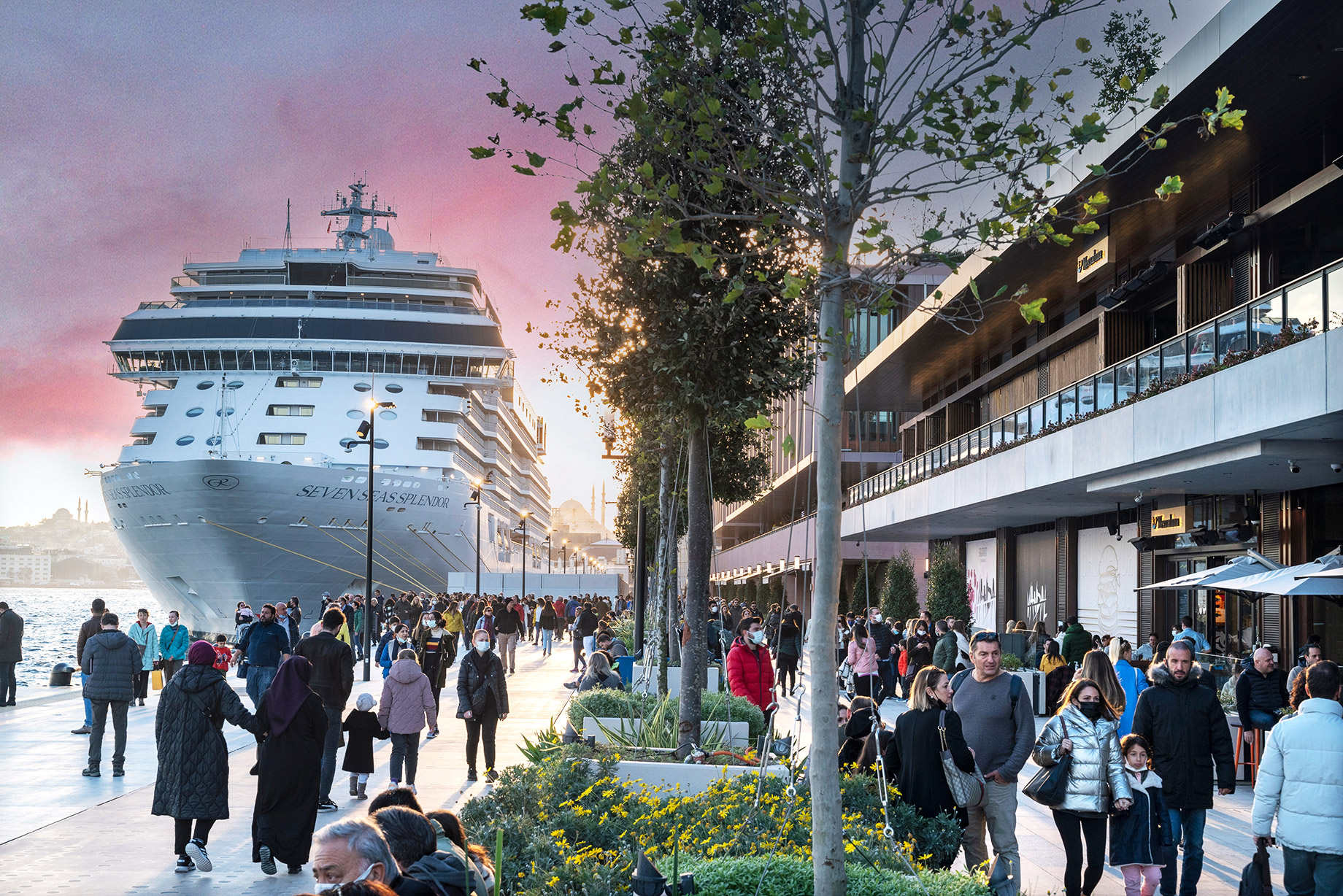
There are destinations that merely impress, and then there are destinations that genuinely transform the way you think about travel. Galataport Istanbul in Türkiye belongs firmly to the second category. Stretching along one of the most storied waterfronts on earth where the Bosphorus meets the Golden Horn and two continents lock eyes across a glittering strait this landmark urban regeneration project has quietly become one of the most talked-about travel destinations in Europe and the Middle East. Whether you are a seasoned connoisseur of luxury travel Istanbul or a first-time visitor stepping off a cruise ship with nothing but curiosity and an appetite, Galataport rewards every kind of traveler with experiences that feel simultaneously ancient and thrillingly modern.
The New Heart of the Bosphorus: Why Galataport is a Must-Visit
Galataport is not simply a port. It is a 1.2-kilometer stretch of reimagined waterfront in the Karaköy district that has been redeveloped into a seamless blend of culture, cuisine, retail, and maritime infrastructure all while preserving the soul of a neighborhood that has been Istanbul’s commercial gateway since the Byzantine era.
What makes it genuinely extraordinary from an architectural and engineering standpoint is that it is home to the world’s first underground cruise terminal. The passenger terminal, processing facilities, and customs infrastructure have been buried entirely beneath the waterfront promenade, meaning that cruise passengers disembark directly into an open public space with unobstructed views of the Bosphorus. There are no towering ship hulls blocking the skyline, no industrial fencing separating the port from the city. The result is a waterfront that feels alive, porous, and deeply connected to the neighborhoods around it something no other istanbul cruise port in the world has managed to achieve at this scale.
The architectural conversation between old and new here is extraordinary. At the heart of the promenade stands the Paket Postanesi (the former Ottoman Post and Telegraph Directorate), a magnificent late 19th-century building that has been meticulously restored and repurposed as a cultural hub. Its ornate stone façade now stands in deliberate, beautiful contrast to the clean lines of the contemporary structures around it a reminder that Istanbul has always been a city capable of holding contradictions with grace. Walking through Galataport, you move between eras effortlessly: a restored neoclassical customs hall, a contemporary art museum designed by a Pritzker Prize laureate, open-air terraces where cargo ships once docked, and independent concept stores tucked into spaces that feel hand-carved from the city itself.
Luxury Redefined: Staying at The Peninsula Istanbul
No the peninsula istanbul review can do full justice to what this property represents in the context of the city. Situated at the northern edge of Galataport with views that span the full width of the Bosphorus, The Peninsula Istanbul is one of the very few hotels in the world where the building itself seems to have been designed around a single, irreplaceable view. The brand, which has long set global benchmarks for luxury travel to Istanbul, has brought its signature philosophy of thoughtful, unhurried service to a city that has arguably deserved it for centuries.
Rooms and suites are finished with materials that reference Istanbul’s layered visual culture intricate tilework, hand-loomed textiles, color palettes drawn from the city’s light at different hours without ever tipping into pastiche. The spa is a serious destination in its own right: hammam rituals updated with contemporary wellness protocols, treatment rooms that feel like private sanctuaries, and a thermal pool from which you can watch container ships move silently across the strait. The rooftop terrace at dusk, when the minarets of the Old City glow gold on the opposite shore and the Bosphorus turns the color of hammered copper, is an experience that belongs on any serious traveler’s list. For those committed to experiencing Istanbul at its most refined, The Peninsula is not merely where you stay it is where the trip properly begins.
A Journey Through Art: Istanbul Modern and Beyond
Galataport has made Istanbul into one of the most compelling art destinations in the world, and no visit is complete without spending serious time at the Istanbul modern museum.
Renzo Piano’s Gift to the City
The İstanbul Modern Müzesi (Istanbul Modern Museum), housed in a purpose-built structure designed by the legendary Italian architect Renzo Piano, reopened on the Galataport waterfront to international acclaim. The building is a masterclass in restraint: generous floor-to-ceiling glazing that floods the galleries with natural Bosphorus light, circulation spaces that feel like a slow, meditative walk rather than a march between rooms, and a rooftop terrace that functions almost as a work of art in itself. The permanent collection surveys the full arc of Turkish modern and contemporary art, from early Republican-era figurative painting to the bold conceptual and video work of the current generation. The temporary exhibition program draws significant international shows, and the museum’s café a glass-walled room suspended above the waterfront is one of the best lunch spots in the city regardless of what’s on the walls.
MSGSÜ Resim Heykel Müzesi
A short walk from Galataport toward the upper streets of Karaköy, the MSGSÜ Resim Heykel Müzesi (the Mimar Sinan Fine Arts University Museum of Painting and Sculpture) holds one of Turkey’s most important collections of 19th and early 20th-century Turkish art. This is where you encounter the painters of the Çallı Generation artists who trained in Paris and returned to Istanbul with Post-Impressionist technique and a burning desire to document a civilization in transformation. The museum is smaller, quieter, and considerably less visited than Istanbul Modern, which means you can spend real time with individual works without competition. It is exactly the kind of hidden gem that enriches an Istanbul modern museum guide with depth and texture.
From Michelin Stars to Iconic Street Foods
The food landscape around Galataport and Karaköy represents one of the most exciting intersections of fine dining and street-level gastronomy in any city in the world.
Fine Dining Excellence: Gallada and Liman Istanbul
Among the best restaurants in Galataport, two names consistently rise to the top of every serious conversation. Gallada, perched on the Peninsula Istanbul’s upper floors with panoramic Bosphorus views, serves a menu that reads as a love letter to Aegean and Anatolian culinary traditions elevated through the lens of modern technique. The grilled seafood, sourced daily from small-scale fishermen working the Sea of Marmara, is exceptional; the meze selection alone justifies the reservation. Liman Istanbul, occupying a prime waterfront position within the Galataport complex, takes a different approach its menu is rooted in classical Bosphorus fish cuisine, with impeccable sourcing and a wine list that champions small Turkish producers alongside international references. Both restaurants require advance reservations and reward the planning.
The Soul of the City: Istanbul Street Foods Around Galataport and Karaköy
For all the excellence of its fine dining, it is arguably the Istanbul street foods scene around Galataport and the surrounding Karaköy streets that best captures the true character of the city. The balık ekmek grilled mackerel layered with onions, lettuce, and a squeeze of lemon in a crusty white roll is an Istanbul institution that has been sold from boats moored near the Galata Bridge for generations. In 2026, the city’s most creative food vendors have taken this tradition and given it a gourmet twist: expect wild herb salads, house-made pickled peppers, and smoked fish variations alongside the classic. Midye dolma mussels stuffed with spiced rice and served open on the half shell with a squeeze of lemon are sold by vendors whose rhythmic shucking and stacking has become a kind of street performance. A kilo of midye dolma from a trusted vendor near Karaköy Meydanı, eaten standing up beside the Bosphorus, costs a fraction of any restaurant meal and delivers more flavor per lira than almost anything else in the city. The simit sellers, the roasted chestnut carts in autumn, the freshly squeezed pomegranate juice stands all of these are not just food; they are the texture of Istanbul itself.
Curated Experiences: Exclusive Galata Tours
Mokan Travel’s Personalized Routes Through the City’s Layers
The streets above Galataport the winding lanes of Karaköy that climb toward the iconic Galata Tower contain some of Istanbul’s most compelling architecture, culture, and hidden history. But navigating them well requires local knowledge that no map or app fully provides. The galata tours offered by Mokan Travel are designed precisely for travelers who want more than a surface reading of the neighborhood. Routes are built around your interests: for architecture enthusiasts, a circuit through the Genoese-era fortifications, the Art Nouveau facades of the banking district, and the Ottoman hans (caravanserais) repurposed as artisan workshops. For food lovers, a guided wander through the covered markets of Karaköy, the rooftop beekeepers, the women’s cooperative producing hand-painted ceramics in a restored 16th-century building.
Local Stories and Hidden Passages
What distinguishes a genuinely well-crafted galata tours experience from a standard group tour is the quality of the narrative the stories attached to specific doorways, the significance of a particular fountain in a particular courtyard, the family that has been selling the same spice from the same stall for four generations. Mokan Travel’s guides are deeply embedded in the city’s cultural life, which means these stories are not scripted; they are lived. The hidden passages (the pasajlar) that cut through the blocks between the main streets glass-roofed Victorian arcades, Ottoman-era covered bazaars converted into music venues and independent bookshops are among Galataport’s best-kept secrets, and they are exactly the kind of place a vip istanbul travel agency worth the name will take you.
Seamless Arrival: Premium Istanbul Airport Transfer
The Most Comfortable Route from the Airport to Galataport
Istanbul is served by two major airports: İstanbul Havalimanı (IST), the vast new hub on the European side, and Sabiha Gökçen Havalimanı (SAW), on the Asian side. Both are significant distances from Galataport, and arrival in a major international city after a long-haul flight is the moment when the quality of your transfer arrangements makes or breaks the first impression of your trip.
Why Istanbul Airport Transfer with Mokan Travel Is the Right Choice
The case for Istanbul airport transfer with Mokan Travel is straightforward and compelling. The service operates a fleet of premium, late-model vehicles from executive sedans to full-size VAN options for families or small groups all maintained and driven by professionally trained, English-speaking chauffeurs. There is no standing at taxi ranks, no negotiating fares, no uncertainty. Your driver is at the arrivals hall with a personalized sign before your bags arrive on the carousel. The luxury chauffeur service Istanbul experience provided by Mokan extends well beyond the vehicle itself: drivers are knowledgeable about the city, can adjust routes in real time to avoid congestion, and can accommodate stops a fish sandwich at a Bosphorus-side kiosk, a quick photo stop at a viewpoint on the way to your hotel. For travelers arriving at IST for the first time, the route in from the airport crosses rolling landscape on the outskirts of the European city before the skyline of historic Istanbul eventually appears on the horizon, minarets and all; having a driver who can contextualize what you are seeing makes it far more memorable. The istanbul airport transfer service is available 24 hours, covers both IST and SAW, and can be arranged for private group transfers for larger parties. For anyone serious about luxury travel in Istanbul, this is not a convenience it is a baseline.
Practical Information for the Modern Traveler
Galataport is open to the public year-round, and the waterfront promenade is free to access at all hours. İstanbul Modern is open Tuesday through Sunday, from 10:00 to 18:00 (Thursday until 20:00), with an entrance fee of approximately 200–250 TRY as of 2026 (free on Thursdays after 18:00). The MSGSÜ Resim Heykel Müzesi keeps similar hours and charges a nominal entrance fee; it is closed on Mondays.
The neighborhood is walkable and well-connected. The Karaköy tram stop (T1 line) is directly adjacent to the Galataport entrance, providing easy access to the Grand Bazaar, Sultanahmet, and the main tourist areas of the historic peninsula in under 15 minutes. The Karaköy ferry terminal, which serves routes across the Bosphorus to the Asian side and up the Golden Horn, is a five-minute walk. For those arriving by cruise ship, the underground terminal at Galataport puts you directly on the promenade there is no transit required; you step off the ship and into the city.
The best time to visit Galataport is either spring (April–June) or early autumn (September–October), when temperatures are mild, daylight is generous, and the Bosphorus is at its most photogenic. Summer is busy especially the July and August cruise season but the waterfront is designed to absorb crowds better than almost any comparable destination in the city. For those considering private Bosphorus tours, morning departures offer the most dramatic light and the calmest water; a private yacht charter departing from the Galataport jetty at sunrise, with the mosques of the Old City emerging from the mist on the southern horizon, is one of the most purely beautiful experiences Istanbul can offer.
For boutique shopping Karaköy, the surrounding streets are home to a compelling mix of independent concept stores, Turkish designer showrooms, artisan ceramics studios, and vinyl record shops. The concentration of creative retail between Kemeraltı Caddesi and the Galata Tower has grown significantly in recent years, making a leisurely afternoon of discovery here a legitimate alternative to the Grand Bazaar quieter, more personal, and with a much higher ratio of genuinely original product to tourist souvenir.
Istanbul in 2026 is a city that has found a new confidence in its own identity global and local, ancient and contemporary, gastronomically serious and gloriously informal all at once. Galataport is where that identity is most fully expressed. Plan carefully, arrive unhurried, and trust the city to do the rest.