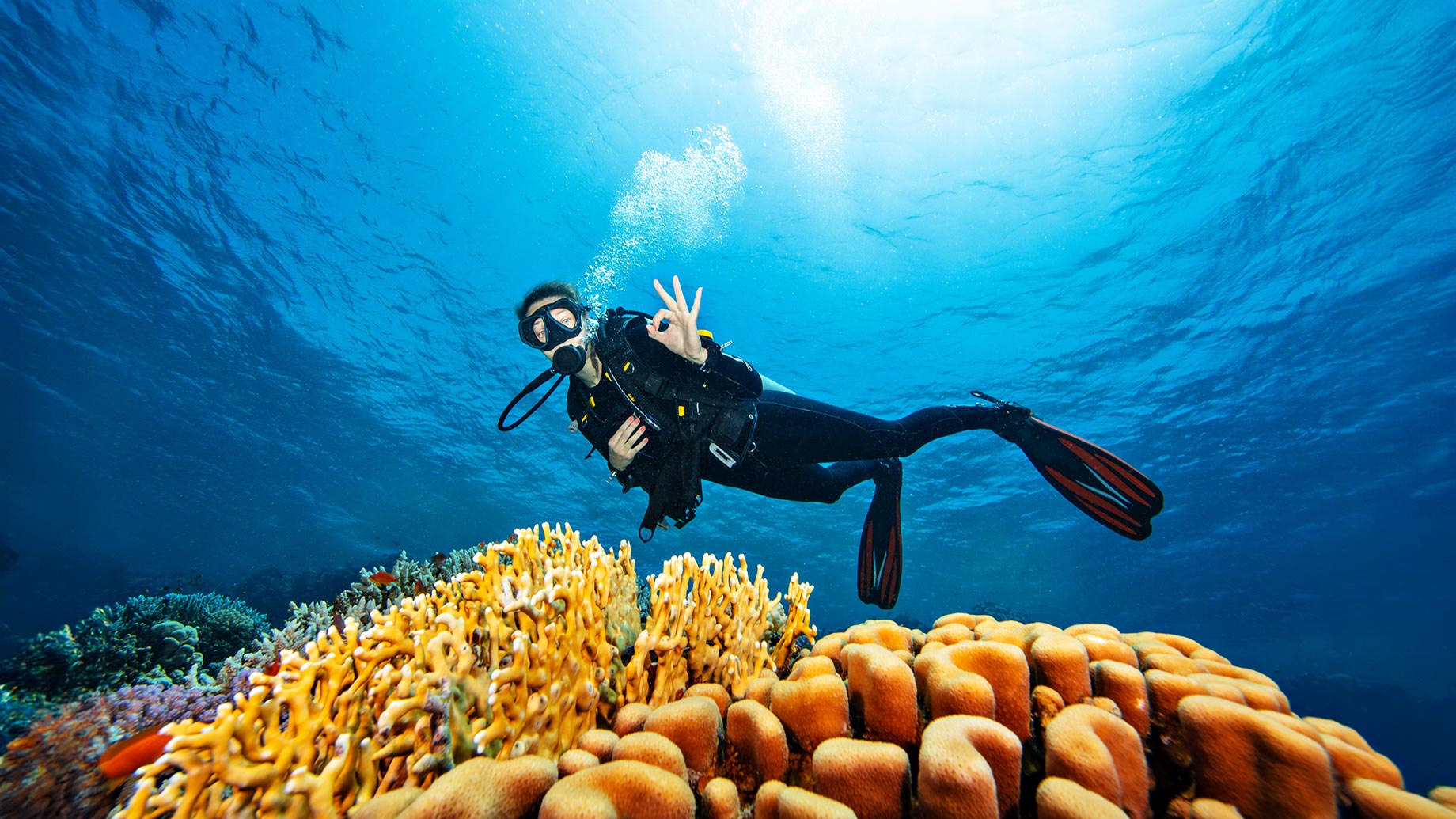
Beneath the surface of our planet’s oceans lies a realm of wonder that transforms first-time divers into lifelong enthusiasts. The weightless feeling of gliding through crystal-clear waters, surrounded by vibrant marine life, creates memories that last a lifetime. Scuba diving offers a passport to another world. Whether you’re drawn to massive manta rays, tiny nudibranchs, or historic shipwrecks, the perfect diving destination awaits your discovery.
In this guide, we’ll explore ten extraordinary diving destinations that showcase the incredible diversity of our underwater world.
1. Nusa Lembongan Island, Bali
Just a 30-minute boat ride from Bali’s mainland, Nusa Lembongan offers some of Indonesia’s most exhilarating diving experiences. This small island paradise is surrounded by clear waters, healthy coral reefs, and vibrant marine life, making it a favorite destination for divers of all levels.
Blue Corner stands out as one of the island’s most thrilling dive sites. Known for its strong currents and excellent visibility, it attracts experienced divers eager to spot schools of trevallies, eagle rays, and even the occasional mola mola during the colder months. The site’s dramatic wall and abundant marine life create a truly exciting underwater experience.
For those who prefer gentler conditions, Mangrove Point on the island’s north coast offers a beautiful drift dive over lush coral gardens teeming with reef fish, turtles, and colorful soft corals. The slow-moving current makes it ideal for underwater photography and relaxed exploration.
Beyond these highlights, Bali is home to several vibrant reef systems where divers can encounter moray eels, nudibranchs, and graceful sea snakes gliding through the corals. The island also attracts aspiring dive professionals from around the world who come and join divemaster courses in Bali, as many local dive centers here offer hands-on training combined with real conservation and guiding experience in some of the island’s most pristine waters.
2. Providenciales, Turks and Caicos
The Caribbean island of Providenciales (locally known as “Provo”) offers diving experiences that stand in stark contrast to Bali’s volcanic landscapes. Here, the main attraction is the third-largest barrier reef system in the world, featuring dramatic wall dives that begin in shallow water before plunging thousands of feet into the abyss.
What sets Providenciales apart is its exceptional visibility, often exceeding 100 feet (30 meters). This crystalline clarity transforms wall diving into a surreal experience, as you hover alongside vertical coral gardens while peering into the deep blue beyond. The walls are adorned with massive barrel sponges, intricate sea fans, and colorful tube sponges that create a living tapestry.
Grace Bay, West Caicos, and French Cay offer the island’s signature wall dives. Each site features unique topography, from swim-throughs and caverns to sand channels cutting through the reef. Marine life includes reef sharks, eagle rays, turtles, and occasional hammerhead sightings in winter months.
For macro enthusiasts, Providenciales delivers with seahorses, flamingo tongues, and a variety of blennies hiding among the corals. The combination of dramatic walls, exceptional visibility, and diverse marine life makes this destination a favorite among underwater photographers.
3. Raja Ampat, Indonesia
While Bali offers exceptional diving, Raja Ampat represents the pinnacle of marine biodiversity on our planet. Located in Indonesia’s West Papua province, this remote archipelago sits at the heart of the Coral Triangle and hosts more than 1.600 fish species and 75% of the world’s known coral species in a relatively small area.
Raja Ampat’s isolation has preserved its underwater ecosystems in near-pristine condition. Dive sites like Melissa’s Garden and Cape Kri showcase coral coverage that approaches 100%, creating underwater landscapes that seem almost impossibly vibrant and healthy. Cape Kri holds the world record for the most fish species counted in a single dive (374).
The region’s unique geography creates a variety of diving environments. Narrow channels between islands generate exhilarating drift dives where nutrient-rich currents attract schools of jacks, barracuda, and reef sharks. Protected bays offer calm conditions for exploring mangroves and seagrass beds where juvenile fish develop.
Raja Ampat’s signature marine residents include wobbegong sharks, walking sharks, pygmy seahorses, and an astonishing variety of nudibranchs. The region also hosts manta rays year-round at cleaning stations, making it a reliable destination for encounters with these majestic creatures.
4. Watamula, Curacao
Curacao’s northwestern tip hosts Watamula, a dive site whose name translates to “water mill” in the local Papiamento language, a fitting description for the swirling currents that characterize this dynamic location. Unlike Bali’s volcanic black sand environments, Watamula showcases the Caribbean’s signature clear waters and unique coral formations.
The site’s most distinctive feature is its mushroom-shaped coral structures, formed by centuries of current patterns sculpting the reef. These formations create a surreal underwater landscape that provides habitat for a remarkable diversity of marine life. The currents that shaped these structures also bring nutrients that support healthy coral growth and attract schools of fish.
Watamula offers two primary dive profiles. The outer reef features a gentle slope descending to about 100 feet (30 meters), where larger pelagics like eagle rays and turtles are commonly spotted. The inner reef provides a more protected environment with coral gardens harboring seahorses, frogfish, and a variety of crustaceans.
What makes Watamula particularly special is the interaction between topography and currents. As water flows around the island’s point, it creates a nutrient-rich environment where soft corals and sponges thrive in vibrant oranges, purples, and yellows. The site’s accessibility from shore makes it popular for both day and night diving.
5. Red Sea, Egypt
The Red Sea offers a completely different diving experience from Bali’s volcanic landscapes, yet rivals it in marine diversity and underwater attractions. Egypt’s stretch of the Red Sea, particularly around the Sinai Peninsula and Hurghada, combines exceptional visibility, comfortable water temperatures, and an intriguing mix of shipwrecks and vibrant reefs.
The region’s most famous dive site is undoubtedly the SS Thistlegorm, a British transport ship sunk during World War II. This underwater museum contains remarkably preserved cargo including motorcycles, trucks, rifles, and boots, all encrusted with marine growth and patrolled by schools of glassfish and batfish. The wreck’s size and historical significance make it one of the world’s most celebrated dive sites.
Beyond the Thistlegorm, the Red Sea offers dramatic wall dives at sites like Ras Mohammed National Park, where nutrient-rich currents attract schooling hammerhead sharks and barracuda. The Straits of Tiran feature four coral-covered pinnacles (Jackson, Woodhouse, Thomas, and Gordon) that rise from the depths, creating dramatic underwater topography.
What distinguishes Red Sea diving is the remarkable clarity of the water, with visibility regularly exceeding 30 meters, and the vibrant colors of the hard and soft corals. The region’s isolation from major population centers has helped preserve reef health, making it a window into what healthy coral ecosystems should look like.
6. Koh Tao, Thailand
While Bali offers exceptional diving for experienced underwater explorers, Koh Tao has earned its reputation as the world’s most popular destination for beginner divers. This small island in the Gulf of Thailand certifies more new divers annually than any other location, thanks to its combination of shallow, protected sites, affordable training, and reliable marine life encounters.
Koh Tao’s signature dive sites include Chumphon Pinnacle, a granite formation rising from the seabed that attracts schools of barracuda and occasional whale shark visits. Shark Island offers dramatic underwater topography with swim-throughs and caverns, while Japanese Gardens provides a perfect training ground with its gentle slope and abundant marine life in shallow water.
The island’s turtle population is a major draw, with green and hawksbill turtles frequently spotted at sites like Hin Wong Bay and Shark Island. These reliable encounters make Koh Tao particularly rewarding for new divers experiencing their first marine life interactions.
Beyond its beginner-friendly reputation, Koh Tao offers technical diving opportunities at deeper sites like Southwest Pinnacle and Sail Rock (shared with neighboring Koh Phangan). These locations feature deeper pinnacles, stronger currents, and chances to spot larger pelagics including bull sharks during certain seasons.
7. Cozumel, Mexico
While Bali offers diverse diving environments from muck to reef, Cozumel specializes in one particular diving style: exhilarating drift dives along dramatic coral walls. This Mexican island in the Caribbean Sea sits atop the Mesoamerican Reef system (the second-largest barrier reef in the world) and benefits from the constant flow of the Yucatan Current.
Cozumel’s signature diving experience involves being dropped at the start of a site, riding the current as it carries you effortlessly along towering coral formations, and being picked up by your boat at the end point. This effortless movement allows divers to cover significant distances while conserving air and enjoying panoramic reef views.
The island’s most celebrated sites include Palancar Reef, with its series of coral pinnacles and swim-throughs; Santa Rosa Wall, featuring a dramatic vertical drop adorned with massive sponges and sea fans; and Columbia Deep, where eagle rays and turtles are frequently spotted against a backdrop of coral formations that seem to defy gravity.
What distinguishes Cozumel from other Caribbean destinations is the remarkable health and size of its coral structures, the clarity of its waters (visibility regularly exceeds 30 meters), and the reliability of its currents. These factors combine to create a diving experience that feels like flying through an underwater canyon of living color.
8. Cancun, Mexico
While Bali offers volcanic landscapes and vibrant reefs, Cancun provides access to one of the world’s most unique diving environments: the cenotes of the Yucatan Peninsula. These freshwater sinkholes formed by the collapse of limestone bedrock create an otherworldly diving experience that contrasts dramatically with traditional ocean diving.
The cenotes connect to the world’s largest underground river system, offering divers the opportunity to explore crystal-clear freshwater caverns where sunlight filters through openings in the ceiling, creating mesmerizing light beams that dance through the water. Popular cenotes like Dos Ojos, The Pit, and Gran Cenote feature distinctive formations including stalactites, stalagmites, and fossilized shells from when the region was underwater millions of years ago.
Beyond the cenotes, Cancun provides access to the northern section of the Mesoamerican Reef. The MUSA (Underwater Museum of Art) offers a unique diving experience featuring over 500 life-sized sculptures placed on the seabed. These sculptures serve as artificial reefs, gradually being transformed by coral growth and marine life colonization.
Cancun’s waters also host seasonal visitors including bull sharks (November to March) and whale sharks (June to September). The combination of cenote diving, reef experiences, and opportunities to encounter larger pelagics makes Cancun a surprisingly diverse diving destination despite its reputation for mass tourism.
9. Cocoa, Maldives
The Maldives offers a diving experience that differs significantly from Bali’s volcanic landscapes, focusing instead on channel dives, reef systems, and pelagic encounters. Cocoa Island exemplifies the luxury diving experience that has made the Maldives famous, combining pristine reefs with upscale accommodations and exceptional service.
The signature diving experience in the Maldives involves “thilas” (underwater pinnacles) and “kandus” (channels between atolls). These channels funnel nutrient-rich water, creating feeding grounds that attract manta rays, whale sharks, and various shark species. Cocoa Island’s proximity to several productive channels makes it an ideal base for experiencing these thrilling dives.
Cocoa Corner and Kandooma Thila rank among the region’s most celebrated sites, offering reliable manta ray encounters during the northeast monsoon (December to April). Guraidhoo Corner provides shark experiences with gray reef, whitetip, and occasionally hammerhead sharks patrolling the reef edge where it meets the blue water.
What distinguishes Maldivian diving is the combination of healthy hard coral gardens in shallow water and dramatic drop-offs where pelagics patrol. The region’s strict marine protection measures have preserved reef health, while the geographical isolation of the atolls creates unique marine ecosystems with endemic species found nowhere else.
10. Bora Bora, French Polynesia
While Bali offers volcanic black sand and vibrant reefs, Bora Bora presents a completely different underwater landscape dominated by a vast lagoon enclosed by a barrier reef. This French Polynesian paradise combines exceptional visibility, comfortable water temperatures, and a unique marine ecosystem centered around its iconic lagoon.
Bora Bora’s signature diving experience involves exploring the “Lagoonarium,” a natural aquarium within the protected waters of the lagoon. Here, blacktip reef sharks, lemon sharks, and eagle rays cruise over pristine white sand, creating dramatic contrasts that underwater photographers cherish. The shallow depth and calm conditions make these encounters accessible even to novice divers.
Outside the lagoon, the outer reef offers more challenging diving with drift opportunities along walls where gray reef sharks, Napoleon wrasses, and occasionally manta rays patrol. Sites like Tapu and Teavanui Pass feature healthy hard coral coverage and the chance to spot pelagics being funneled through the narrow channels that connect the ocean to the lagoon.
What makes Bora Bora truly special is the juxtaposition of its underwater world against the backdrop of Mount Otemanu, the island’s dramatic volcanic peak. This creates a unique diving experience where the topside scenery rivals the underwater attractions, making surface intervals as memorable as the dives themselves.
Fun Activities Scuba Divers Can Do
Beyond exploring the world’s best dive sites, scuba diving opens doors to specialized activities that enhance your underwater experiences. Whether you’re visiting Bali or any other destination on our list, consider these engaging pursuits to deepen your connection with the marine environment.
Underwater Photography
Capturing the underwater world through photography transforms how you experience diving. Bali offers exceptional opportunities for both wide-angle and macro photography. The black volcanic sand at sites like Seraya Secrets provides the perfect backdrop for photographing colorful nudibranchs, frogfish, and other small critters that pop against the dark substrate.
For beginners, many dive centers offer underwater photography courses that cover basic techniques, lighting, and composition. These skills enhance not just your photos but your overall diving experience as you develop a more observant eye for marine life behavior and habitat details.
Advanced photographers will find Bali’s diverse environments perfect for expanding their portfolios. From wide-angle opportunities with manta rays at Nusa Penida to super-macro subjects at Tulamben’s Liberty Wreck, the island offers photographic challenges for every skill level and equipment type.
Join Conservation Programs
Transforming your dive vacation into a force for positive change creates memories with lasting impact. Many destinations now offer opportunities to participate in marine conservation efforts, from coral restoration to data collection for scientific research.
In Bali, several organizations offer the chance to combine diving education with conservation work. Taking a divemaster conservation in Nusa Lembongan often includes training in reef assessment, marine identification, and conservation techniques. These programs allow you to develop professional diving skills while contributing to environmental protection.
Nusa Lembongan has become a hub for manta ray research, with projects that track individual rays through photo identification. Visitors can contribute their manta photographs to databases that help scientists monitor population health and movement patterns. This citizen science approach allows even recreational divers to make meaningful contributions to marine research.
Night Diving Adventures
Experiencing the reef after dark reveals an entirely different ecosystem as nocturnal creatures emerge from their daytime hiding places. Night diving transforms familiar sites into new adventures, with changes in marine behavior and activity that even seasoned divers find fascinating.
Bali offers exceptional night diving opportunities, particularly at the Liberty Wreck in Tulamben. After dark, the wreck comes alive with hunting morays, flashlight fish with their bioluminescent patches, and Spanish dancers, large red nudibranchs that swim with graceful undulations when disturbed.
Is Scuba Diving Dangerous?
Scuba diving, when approached with proper training and respect for safety protocols, is statistically safer than many common activities including driving a car. The perception of danger often stems from the underwater environment being unfamiliar rather than inherently hazardous.
The key to safe diving lies in proper training and certification. Organizations like PADI, SSI, and NAUI provide structured education that builds skills progressively, ensuring divers understand both the physics and physiology of diving before venturing into more challenging environments. In Bali, numerous reputable dive centers offer courses from beginner to professional levels with excellent safety records.
Modern diving equipment includes multiple redundancy systems and has become increasingly reliable. Most diving incidents result from human factors rather than equipment failure, emphasizing the importance of good judgment, proper planning, and diving within your training and comfort limits.
Safety Factors in Modern Diving
- Standardized training protocols
- Reliable equipment with redundancy systems
- Conservative dive planning guidelines
- Buddy system for mutual assistance
- Pre-dive safety checks and briefings
Risk Factors to Manage
- Diving beyond training/experience level
- Ignoring weather or current conditions
- Inadequate equipment maintenance
- Diving with untreated medical conditions
- Failure to plan for emergencies
Time to Explore Diving Destinations Around The World
Whether you’re drawn to underwater photography, marine conservation, or simply the peaceful sensation of weightless exploration, scuba diving opens doors to experiences that transform how you see our blue planet. The skills you develop and the marine life encounters you enjoy create memories that last a lifetime.